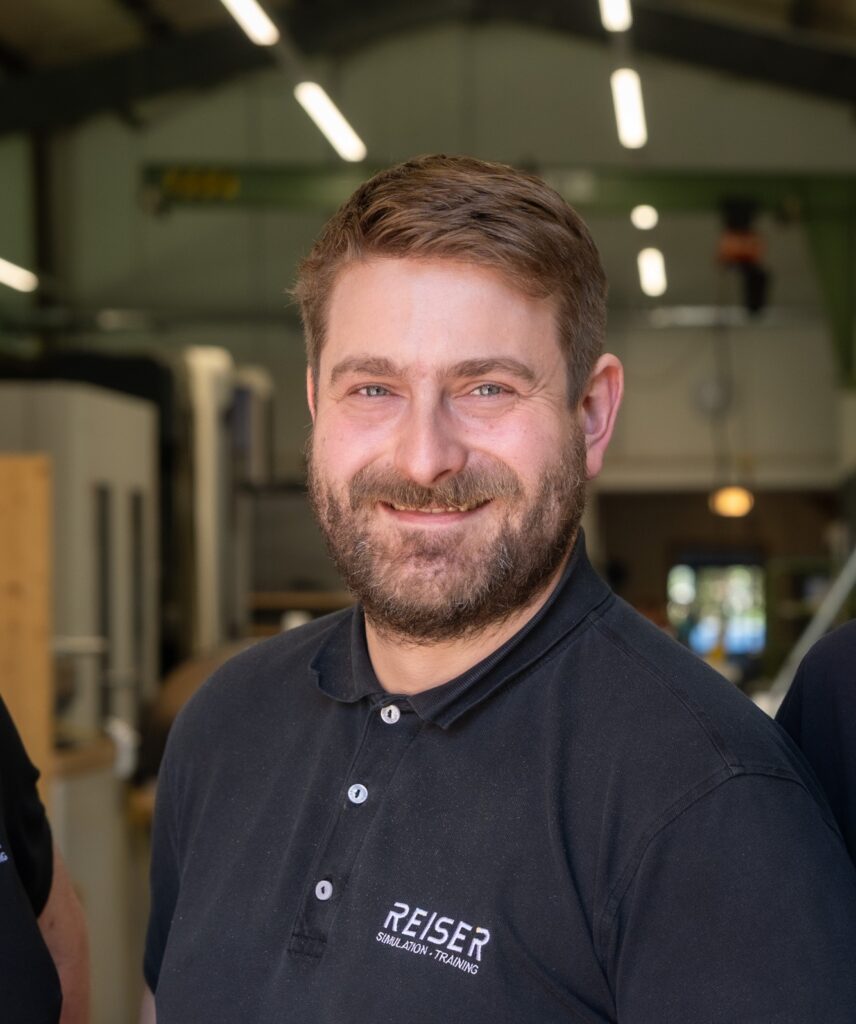

expert review by Tim Faro - Junior Product Owner
AI in simulation and training refers to the use of artificial intelligence to adapt training scenarios, analyse performance data and support instructors in planning and assessment. It complements existing simulators; it neither replaces the training systems nor the professional judgement of people.
In a simulator, many things are precise: system states, flight models and procedures. What is often less precise is the view of how an individual learning path develops across several training situations.
That is where the discussion about artificial intelligence in simulation and training begins. Not because modern simulators are unable to deliver. But because additional analytical and adaptive capabilities could help them respond more precisely to people, tasks and learning progress.
Tim Faro approaches this question from a clear perspective: AI should not replace what already works. It should add another capability layer to high-performance simulators - making training more adaptive, scalable and data-based.
At a glance
AI can adapt training scenarios to the current learning level.
Data from several sessions can reveal patterns that remain hidden in a single debriefing.
Professional assessment remains with people: AI provides evidence and indications, while instructors interpret them.
Strong Simulators, Static Workflows
Modern simulators reproduce complex systems realistically and create a safe environment for situations that cannot be practised repeatedly in real operations. Tim Faro does not question that strength.
The challenge lies elsewhere. Many scenarios are created manually. Training procedures are defined in advance. After the session, performance and progress are assessed manually again. This works, but it takes time and allows only limited variation and personalisation.
Recognising patterns reliably across several training sessions is also demanding. A single observation can matter - but it does not always show whether a skill is improving over time, whether uncertainty returns under certain conditions or whether a problem has simply shifted to another situation.
AI is therefore not interesting because existing simulation is insufficient. It is interesting because strong simulators could be used even more purposefully with additional analytical and adaptive capabilities.
When Training Responds to the Current Learning Level
A training scenario does not have to unfold in the same way for every pilot. The right level of challenge depends on what someone already handles confidently, where uncertainty remains and how performance develops across several sessions.
During training, AI could continuously analyse what is happening and adjust selected parameters: weather conditions, the number of other traffic participants, the timing of a malfunction or the difficulty of a task.
The aim is to find the right point of challenge. The task should be demanding enough to trigger learning, but not so difficult that the person loses track of the situation. At the same time, training time should not be spent on procedures that are already mastered.
For AI-supported pilot training, this could create a more individual learning path. It also provides a basis for Competency-Based Training and Assessment, where the focus is not only on one procedure but on the development of competencies across several training situations.
Data That Tells More Than a Single Session
Training produces many kinds of data: control inputs, reaction times, procedures and responses to system states or malfunctions. AI can analyse this information across several sessions and make recurring patterns visible.
Does a particular uncertainty keep returning? Does it occur only under certain conditions? Is performance better in the next session - or has only the way the problem appears changed?
Data-based performance assessment can support the debriefing. It makes developments easier to compare and helps align feedback more closely with the person and their learning curve. Individual data points become a longer-term picture.
The aim is not to replace the experience of instructors with an automated score. AI can provide indications and highlight relevant patterns. Professional interpretation remains where context, experience and responsibility come together.
AI Can Measure. People Need to Interpret.
This distinction matters, especially when assessing pilots. AI can capture measurable aspects such as reaction times, control inputs or adherence to procedures. It can make patterns across several sessions visible and create a stronger basis for the debriefing.
But whether a reaction was appropriate in a particular situation cannot always be inferred from a measurement. Situational awareness, decisions under pressure and the context of a training history require human interpretation.
The sensible approach is therefore a clear division of work: AI provides evidence. Instructors assess, explain and decide. Technology supports training - it does not replace professional responsibility.
Developing Flight Models with Data and Physics
AI can play a role beyond the training session itself. Tim Faro also sees potential in flight model development.
Aerodynamic behaviour is described through flight models whose creation can be time-consuming. At the same time, large amounts of flight and simulation data are available. Neural networks could identify patterns in this data and help create or adapt new aircraft configurations more quickly and flexibly.
A model should not only produce statistically fitting results; it should also behave in a physically plausible way. One established technique for this is the Physics-Informed Neural Network (PINN), often used in the plural as Physics-Informed Neural Networks (PINNs). The network learns from available data. At the same time, training steers it towards respecting fundamental physical relationships.
Even then, a neural network remains, at least in part, a black box. The approach is therefore not fully transparent. But it is not a purely data-driven model that can produce arbitrary results outside its training data. Instead, it combines the strengths of data and neural networks with physical knowledge. This can contribute to flight models that are more robust, more understandable and, for certain applications, more transferable.
From Potential to Responsible Application
The path from an idea to an application does not begin with the question of where AI can be added. It begins with the conditions under which it can be used sensibly and responsibly.
What data is available? How can the quality of the results be tested? How can recommendations be made understandable? And how can the limits of a system remain visible?
A pragmatic route is to start with clearly defined use cases that can be tested and validated. Instructors should remain part of the process and be able to understand recommendations. Integration should be modular and build on existing systems.
Not every possible AI application has to be implemented immediately. The important thing is to start where a concrete and verifiable training benefit can be identified.
The Next Step Is Not a Restart
The most interesting perspective on AI in simulation is not a spectacular single application. It is the possibility of developing existing systems in a targeted way.
Simulators do not need to be reinvented for training to become more adaptive. Instructors do not need to leave the process for data to be used more effectively. And AI does not need to make every decision to create tangible value.It can make scenarios more variable, tailor learning paths more closely, reveal recurring patterns and support the development of physically plausible models. The better systems structure data and provide useful indications, the more room remains for tasks that require experience, judgement and responsibility.
For Tim Faro, AI is therefore not a shortcut around existing simulation. It is an additional layer built on what already works.