


Whether at the cinema or in a shopping street, large moving projections have become impossible to imagine life without.
The following looks at
- the history and the different types of projector systems,
- two projection methods and
- current and future technologies at Reiser Simulation and Training GmbH (RST)
.
The development of video projectors
The history of video projectors goes back to the 1930s. At ETH Zurich the Eidophor system (image carrier system) was developed at that time. Technically it was the first system able to deliver bright images at high resolution, a combination of television picture tube and film projector.
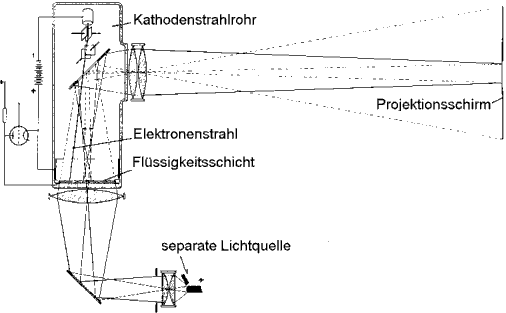
Figure 1: design sketches for the Eidophor process.
Source: NGZ-Neujahrsblatt 1961
In the Eidophor system, an electron beam creates the image on a concave mirror coated with a thin film of conductive oil (called the eidophor, that is, image carrier), which at the same time sits in the light path of a projector. In the rhythm of the television image, the concave mirror produces changes in the reflection of the light beam, which are made visible as a large image on the screen by a system of tiny mirror bars.
The Eidophor system was used in cinemas for the first time in 1960 for the live broadcast of the Olympic Games in Rome.
The generation of CRT projectors, which peaked in the 1990s, creates the image directly with special projection picture tubes (cathode ray tubes) optimized for high brightness. Even so, the room usually has to be completely darkened. Colour projectors need three tubes (blue, green and red) that have to be aligned precisely with each other to avoid colour errors. Because such projectors build the image line by line without pixels, they are very flexible in resolution and can generally display every common video standard up to high-definition video. Because of the three projection tubes, however, they are very bulky and heavy (70 kg and more) and only suitable for fixed installation.
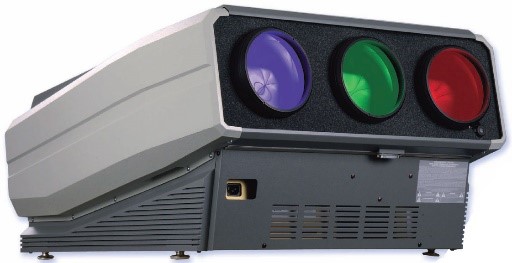
Figure 2: VDC Marquee 8500 CRT projector
Source: HCinema projector database
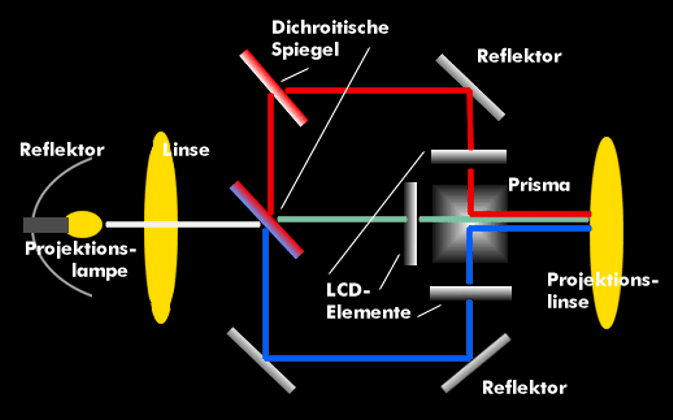
Figure 3: LCD projection with colour separation via dichroic mirrors
Source: ITWissen.info
The use of liquid crystal displays (LCD), initially used in mobile phones among other things, from 1971 onwards led to the generation of LCD projectors. These work like slide projectors, with an LCD display panel where the slide would be. Each of the three primary colours blue, green and red needs its own panel. Cheaper devices make do with a single LCD element, but that results in poorer image quality.
A DLP projector (Digital Light Processing), brought to market by Texas Instruments in 1996, uses a DMD (Digital Micromirror Device) as image converter and a microchip carrying a tiny tilting mirror for every single pixel. This way of creating an image therefore only knows two states, light and dark. Brightness gradations are achieved by tilting at different speeds. The optics and the DMD are encapsulated, which makes them less sensitive to dust and longer-lasting. Colour images are created by a rapidly rotating colour wheel whose segments let red, green and blue through in turn.
Today, mainly LCD and DLP projectors are used,
including in the RST simulators. We primarily use DLP projectors with a laser light source.
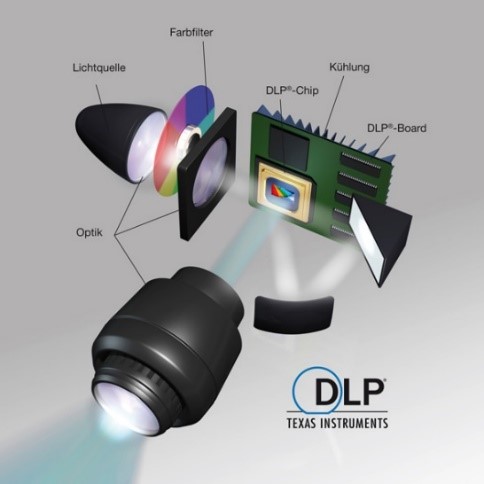
Figure 4: schematic of a DLP projector
Source: beamerstation.de
Besides the different types of projector there are also different projection methods:
collimated and direct projection, both described in more detail below.
Collimated projection
The essential characteristic of a collimated display is that the light rays emanating from a given point in the image are parallel. The parallel rays have two main effects:
- They focus the viewer’s eyes at infinity and have no convergence, which creates the impression that the object is far away.
- The angle to a given point in the image does not change when it is viewed from a different position
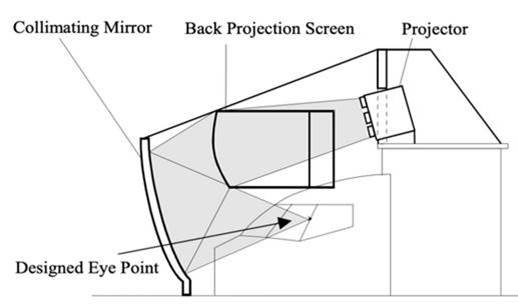
Figure 5: schematic of collimated projection
Source: SOARBYWIRE: Notes on a Collimated System
Collimated projection is used above all in full-flight simulators for fixed-wing aircraft, because there the creation of a depth effect and the smallest possible parallax error are very important, so distant objects can be represented better.
Collimated projection works as follows:
A projector casts its image onto a back projection screen. This collimates the light rays and passes them on to the large collimating mirror. From there the parallel light rays are reflected towards the cockpit.
As a rule, such a projection delivers an image that is no closer than about 6 to 10 m from the viewer, with the distance varying across the field of view.
Direct projection
Besides collimated projection there is direct projection, which so far is used exclusively in the RST simulators. The reason is that RST has so far produced helicopter simulators.
Direct projection is used in helicopter simulators because the scenes shown are mostly close to the cockpit. Unlike with collimated projection, distant objects are not what matters here. What is important for the pilot is being able to look out of the cockpit window and recognize the immediate virtual environment, for example during take-off and landing or during rescue sequences. Representing distant objects is of lesser importance for helicopter pilots in training.
Direct projection works as follows:
The projection screen does not need a reflective surface, only a white coating. Nor is a parabolic mirror needed to collimate the light. Costs are therefore lower and the set-up is considerably simpler.
The projectors cast their image directly onto the screen. The number of projectors depends on the field of view to be covered (the area on which the simulation environment is displayed). Special software calculates and removes the overlap angle of the image areas so that a continuous field of view results.
Given the basic principles described above, it is clear that neither projection method delivers a completely accurate image for all possible object distances (near vs. far). It is important to match the visual system to the respective training content and to the simulated aircraft.
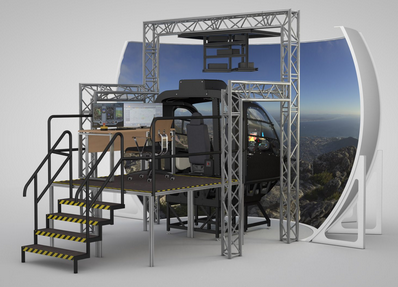
Figure 6: F-LIGHT LINE simulator
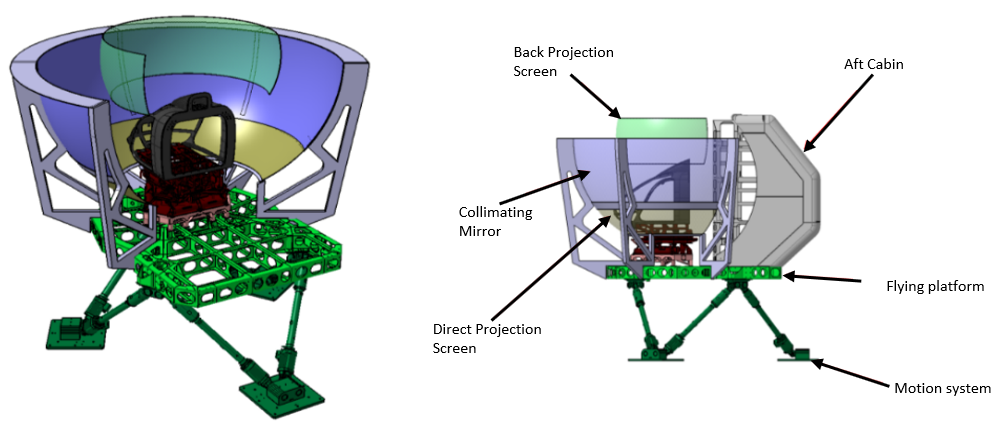
Figure 7: schematic of a combination of collimated and direct projection
RST has already worked on a combination of collimated and direct projection. The idea was to use a collimated display in the upper field of view and a direct one in the lower. The problem is that when the pilot moves their head (a change of position), distortion arises between the collimated and the direct display.
The distortion could be minimized by using a head-tracking system and software solutions. Because of the development risks in terms of effort, the time needed for implementation and achieving quality sufficient for the customer in representing the field of view, the project was stopped after a test set-up. Implementing the concept would have meant that a single dome type would have been sufficient for both aircraft and helicopter simulators.
Current and future technologies
So far, RST flight simulators use direct projection systems exclusively.
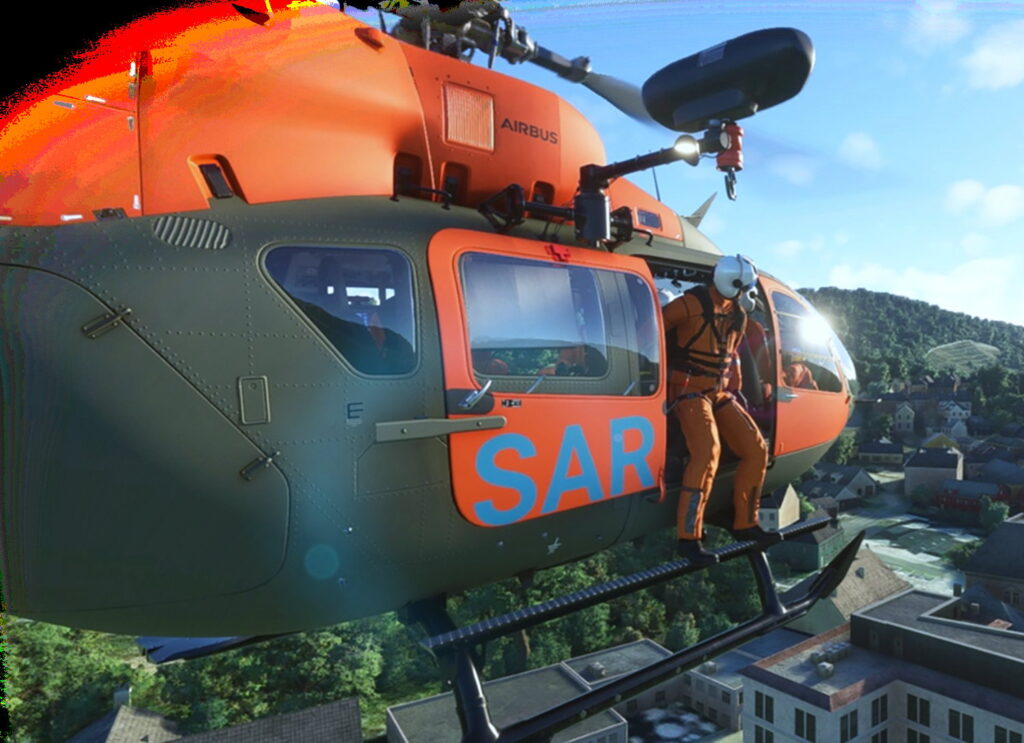
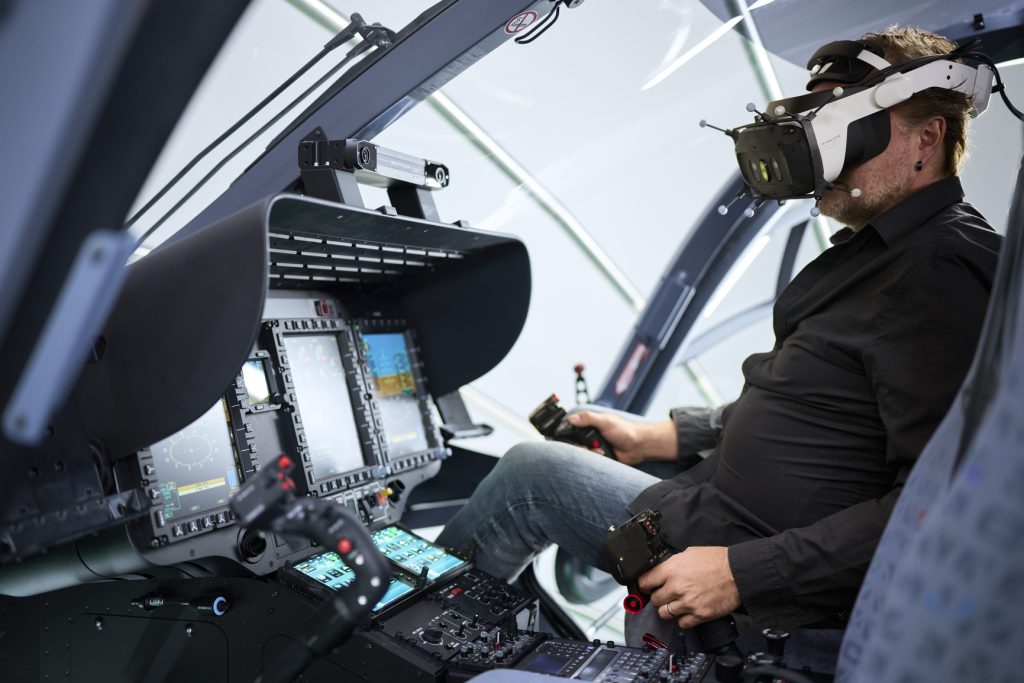
To enable further training content, the hoist simulators use AR technology (augmented reality). The third crew member wears AR glasses. The training value is increased in that the hoist operator sees the hoist cable and the person to be rescued, an avatar, when looking out of the helicopter.
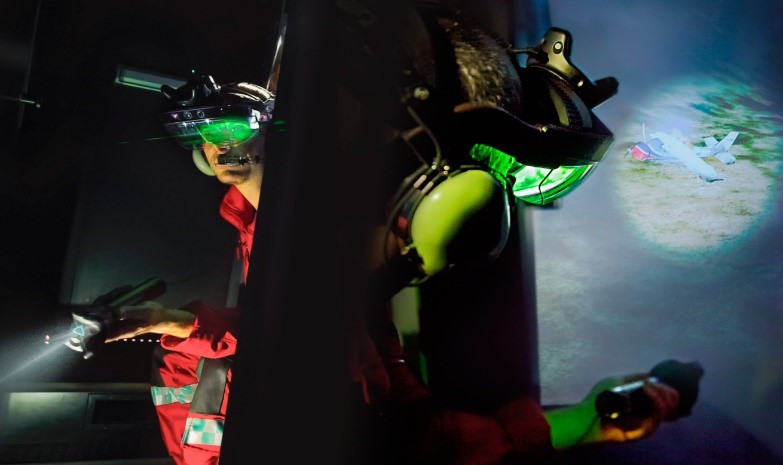
Figure 8: third crew member with AR glasses in a full-flight simulator
The set-up here is considerably simpler than showing such scenarios with projectors, because all elements can be rendered in the glasses and no separate projector installation is needed. In full-flight simulators too, projection systems could be replaced by virtual or augmented reality systems in future.
More information on VR and AR systems can be found in our article on virtual worlds (https://www.reiser-st.com/die-virtuelle-welt/)
Another alternative to conventional projectors is the use of large LED screens. These are mainly used on large advertising boards or at trade fairs. One clear advantage is that the room does not have to be completely darkened and that no calculation of overlap areas and no extra lighting of shaded areas is needed. Purposeful use is currently not possible, because the video panels so far only deliver low resolution.
RST is constantly working to make pilot training more realistic. In addition, RST wants to extend the product portfolio with new technologies so that the wide-ranging training needs of our customers can be covered. The goal is to play a major part in shaping the future of training systems and devices, and to make a substantial contribution to flight safety through significantly smaller and even more faithful simulation systems.