




In this second part I would like to briefly present the key results of my thesis. The topic was:
“Developing a concept for implementing innovation management at a medium-sized company”
A representative survey was carried out to collect data. Ten large companies and ten small and medium-sized enterprises (SMEs), selected at random, took part. At the outset, the number of SMEs that had already implemented some form of innovation management was surprising (around 70 per cent).
It quickly became clear, however, that SMEs organize innovation management far more flexibly than large companies, which as a rule stick closely to theoretical models and principles from the literature. It was also interesting that many companies regard a suitable company culture, meaning one that fosters innovation, as considerably more important than, say, a budget for innovation.
In the end, however, the results showed that SMEs face considerably greater challenges than large companies in successfully implementing innovation management. The reasons are usually scarce resources, the dual workload on employees and the lack of strategic direction in smaller companies.
As the main result of my thesis, both a generally applicable phase plan for implementation and an innovation process tailored to RST were developed. The phase plan sets out the essential steps that should be observed when introducing innovation management. A rough timeline was also defined.
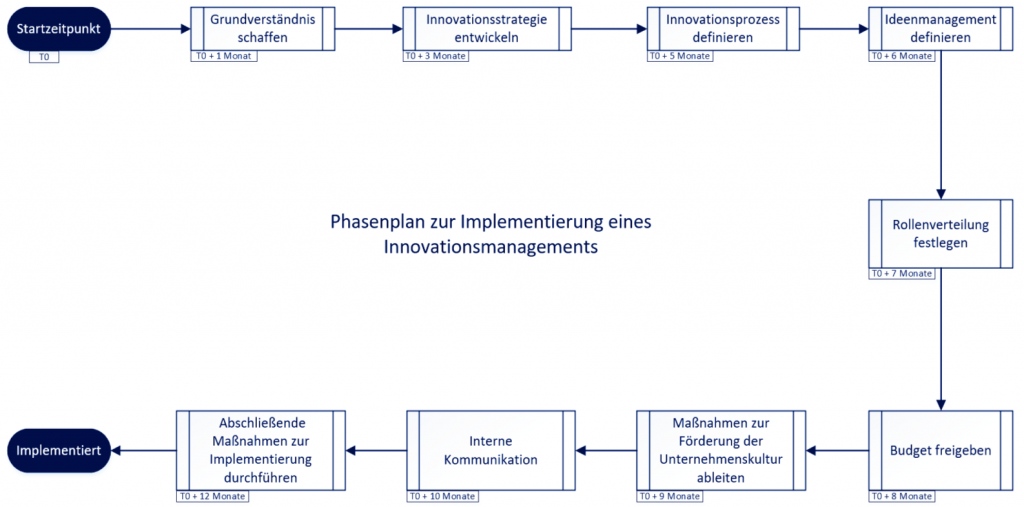
The phase plan above shows nine basic steps. However, they differ in how complex and complicated they are to carry out. Creating a basic understanding, for example, sounds trivial in theory but often proves very difficult in practice.
To check the theoretical phase plan for practicality and for whether its content made sense, my next step was to begin establishing the concept in the company. Three steps emerged as particularly challenging to implement: creating a basic understanding, developing an innovation strategy and, ultimately, establishing a company culture that fosters innovation. Even after months these points could not be fully completed. The innovation process and the allocation of roles, by contrast, were defined quite quickly.
A key challenge in implementation was availability, that is, the spare capacity of employees and managers all the way up to the management board.
The next step was to develop the innovation process for RST. It is based on the stage-gate model, which is also found in other processes at the company. The key insight here was that a model always tries to represent reality as well as possible but assumes a perfect world, and that is rarely what you find in practice. The model therefore had to be adapted considerably to the company’s needs.
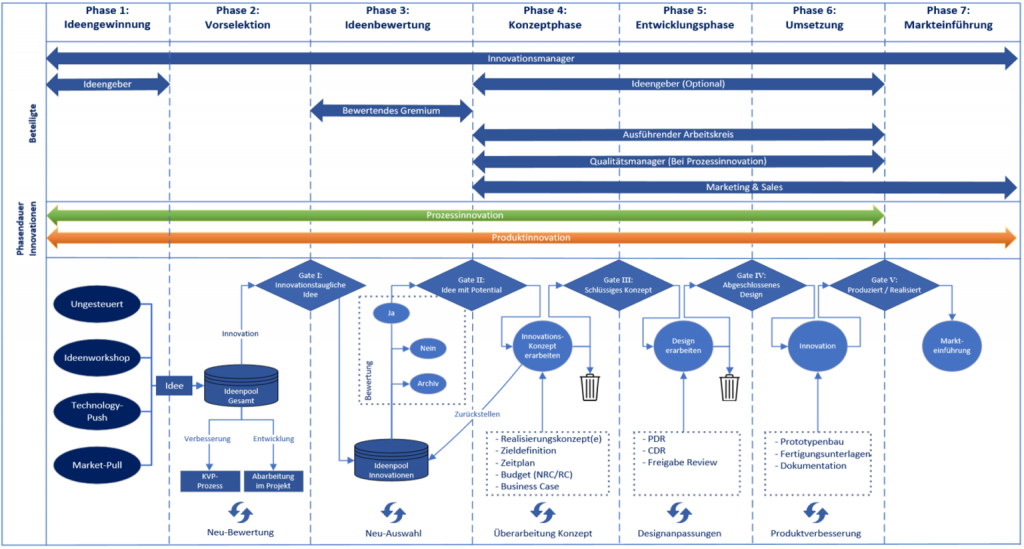
Departing from the standard stage-gate model, it was decided to divide the process into seven phases. Additional steps were added in evaluation and selection in particular, in order to keep the capacity required from committees and larger working groups as low as possible. Only once an idea has been rated as having high potential and has been given a viable business plan is the management board brought in. The gates are also important; they allow quality and progress to be checked regularly in order to prevent large misinvestments.
Finally, as part of my master’s thesis I summarized the current state of implementation and defined further steps for RST. The company’s goal is now to have innovation management fully implemented by the middle of 2021.
If the subject interests you in general or you would like to exchange experiences, feel free to contact us at Jonas.Goercke@reiser-st.com