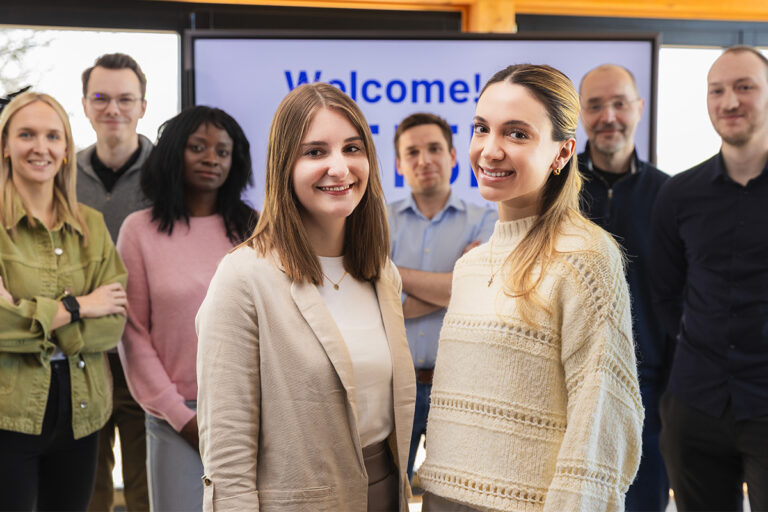
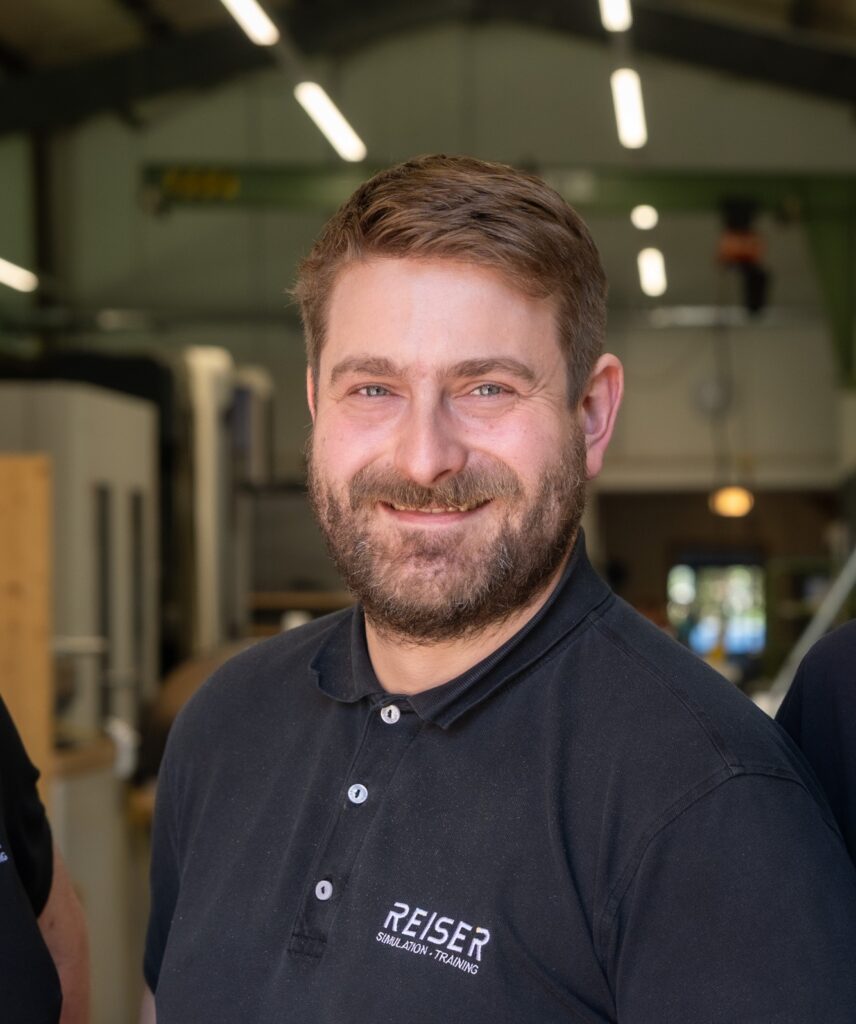




Sarah, a member of the Human Relations team, took that as an occasion to find out more about the profession and to take a closer look at the apprenticeship with us. For this she talked to two colleagues from mechanical manufacturing. Jan, head of the mechanical manufacturing department, gives us an insight into the apprenticeship in his department and explains what you should bring to complete it successfully.
Sebastian, an apprentice in his first year, reports on his experience at RST so far, offers insights into what the precision mechanic apprenticeship covers and tells us what he enjoys most about it.
Sarah: Sebastian, you have been doing your apprenticeship as a precision mechanic with us for about six months now. Why did you choose this apprenticeship? Were there other professions to choose from?
Sebastian: Since I had previously started an apprenticeship as a metalworker, which unfortunately I did not enjoy that much, becoming a precision mechanic was an obvious choice for me. The metalworker apprenticeship takes place mainly on construction sites. During the apprenticeship I realized that in the long run that was unfortunately not what I had in mind. But because I really enjoy working with metal and other materials, I decided on the precision mechanic apprenticeship. Another option would have been the cutting machine operator apprenticeship, for which I also had an interview at the time. However, the training in precision mechanics is more varied and seemed more interesting to me, which is why I finally chose this profession.
Sarah: Why did you choose us as your training company?
Sebastian: First of all I researched the various apprenticeships and the companies offering them online, of course. Since I was mainly interested in the precision mechanic apprenticeship, as I just described, and wanted to stay in the region, I came across RST quite quickly. The number of companies offering this apprenticeship in the region is very small. Through a week of work experience that I was able to do here after my interview, I realized that I felt comfortable and that the varied tasks awaiting an apprentice here appealed to me. So I was happy to choose RST as my training company once the apprenticeship was offered to me.
Sarah: How have the first weeks of the apprenticeship gone for you so far?
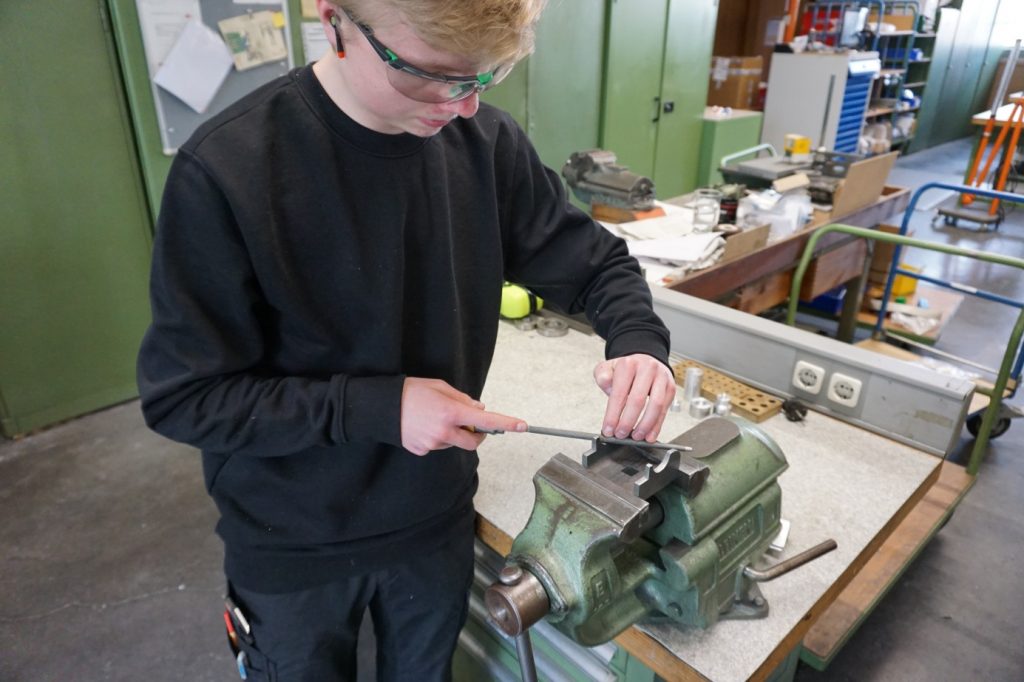
Sebastian: I have settled in very well, both in the team and in the content of the apprenticeship. During onboarding I was of course first introduced to the mechanical manufacturing team. But I was also able to get a brief look at the other departments and sites at the start of the apprenticeship, to get a better insight into the company and its processes. Over time I am now developing an ever better understanding of procedures and operational workflows. That operational understanding is of course complemented by a focus above all on first getting to know the various materials, for example by working them with a file.
Sarah: Which content is mainly taught by the company and by the vocational school during the precision mechanic apprenticeship?
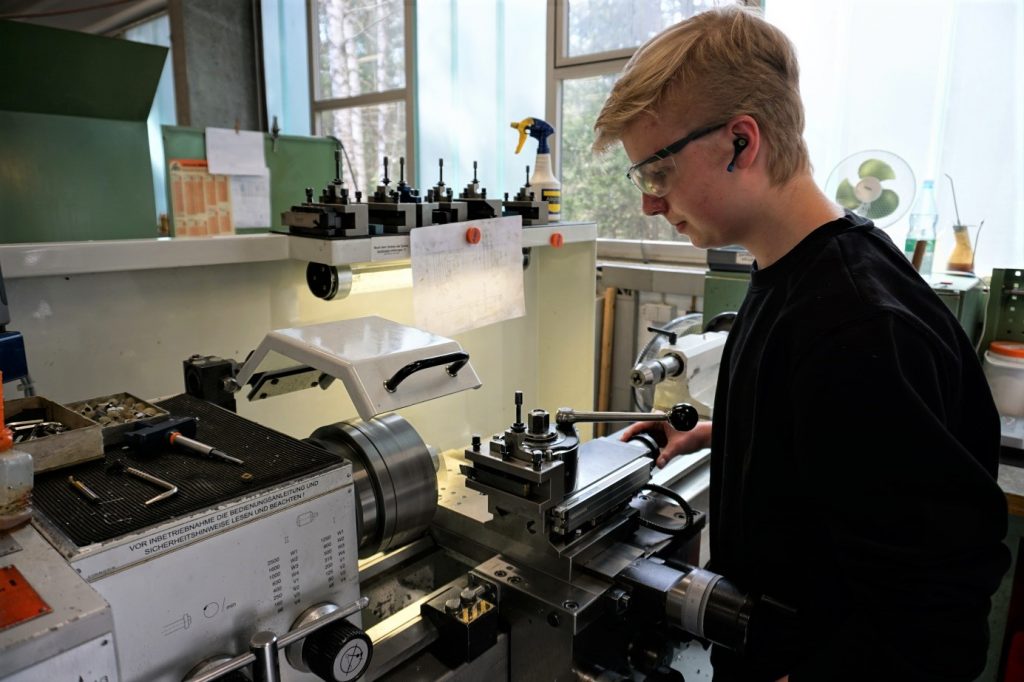
Sebastian: At the company you learn to produce parts on various machines and with different materials. That includes the basics in the form of manual filing, sawing and drilling. The tasks then become more demanding as this work is carried out on the machine. As an apprentice you start on the lathe and after some time move to the manual milling machine. Last come the CNC milling and turning machines. On the lathe you learn to produce steps or threads, for example, and by using different steels your feel for the materials keeps improving. At vocational school I learn the theoretical basis for the practical work at the company. That includes the various steel standards, being able to read technical drawings and machine maintenance. Jan: Naturally, the various ways of working metal and gaining a good feel for materials are at the forefront of this apprenticeship. That is taught especially at the beginning and is an essential prerequisite for the profession.

Sarah: Sebastian, are you allowed to work independently and organize yourself? Or do you have your own areas that you are already responsible for? How does that develop over the course of the apprenticeship?
Sebastian: At the moment I receive my work orders when colleagues hand me drawings with a job, like the pneumatic motor I mentioned earlier. The drawings show what the final workpiece has to look like. I then start by selecting the right materials, do the calculations and machine the part according to the specifications. I handle these orders completely and independently. Of course you do not know everything at the start of an apprenticeship, but I can ask my trainer or one of the other colleagues at any time. They help me with tips or suggestions so that I can then carry on with the job myself. That way I learn very quickly and get good insight into how experienced colleagues see things and why they would or would not do something. As the apprenticeship progresses, the tasks entrusted to me also become more demanding and more extensive. Right at the beginning I mostly did filing exercises and by now I am already working on the lathe. Jan can probably add something about the rest of the apprenticeship and how it develops.
Jan: Yes, of course, gladly. The apprentices first complete their basic training with us. It is important that they learn to machine components independently and gain as broad an insight as possible into the department’s work. Over time the apprentices specialize in one type of machine, usually one of the milling machines in light machining, or else a machining centre in heavy machining. That depends entirely on the apprentice’s interests.
Sarah: Sebastian, what do you enjoy most about the apprenticeship, and why?
Sebastian: The filing at the start of the apprenticeship is important to get a feel for the materials, but honestly it was not my favourite task. I enjoy working on the lathe much more. The feeling of having learned something new every day is very nice and feels good. It makes me more and more independent and means I can be entrusted with more demanding tasks. That makes me proud.
Sarah: What has been the best or coolest workpiece you have made so far?
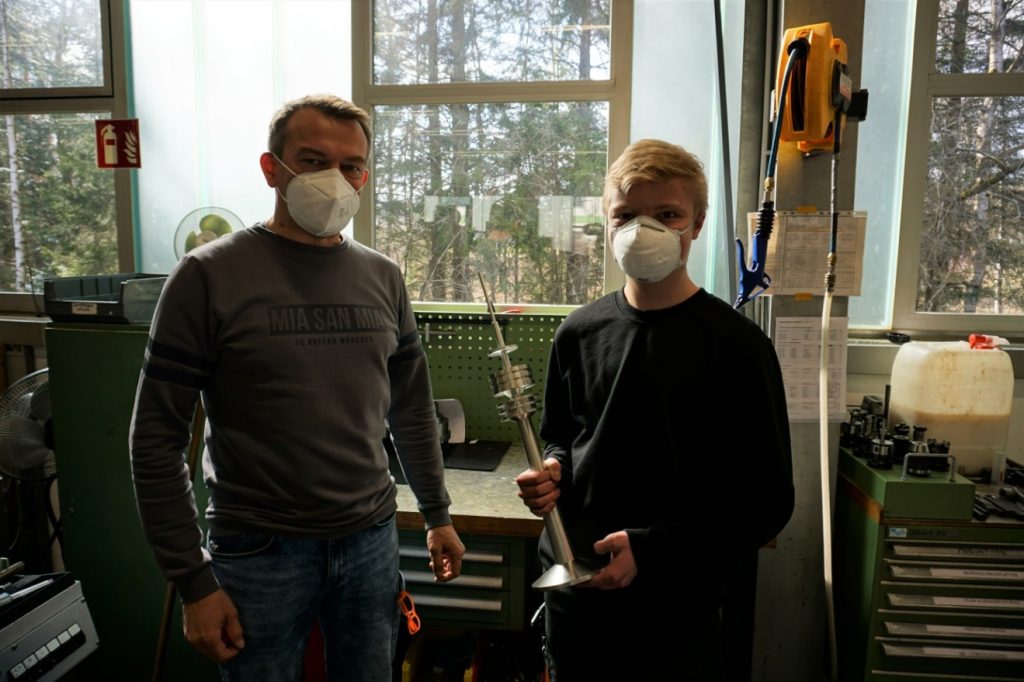
Sebastian: I recently made a model of a television tower. It is a very intricate workpiece and a good practice piece for trying out different machining techniques. I am very proud to have finished the tower and have put it up at home as a memento.
Sarah: Jan, do the apprentices also get insights into other specialist areas and can they visit other departments to gain experience there too?
Jan: Absolutely. The apprentices spend about two months each getting to know electromechanical production and system integration. In electromechanical production, individual components and small assemblies are assembled and wired, including parts that come from our own manufacturing. System integration ultimately installs all components in the final product. It is important that the apprentices know what matters to the other departments that work with the parts we make. They need insight into the whole process and to look beyond their own area, in order to understand the processes as a whole and to assess situations better. We want our apprentices to gain a fundamental understanding so that they can also make better decisions, for example when it comes to solving problems. It also helps them identify with the profession and the company when they see where our workpieces are installed and what they are needed for.
Sebastian: I am really looking forward to getting to know the other departments. When will that be? Jan: The apprentices usually get their insights into electromechanical production and system integration after the intermediate examination.

Sarah: Jan, what in your view makes this apprenticeship at RST special?
Jan: Clearly the flexibility. The apprentices can and should try everything out, gain their own experience and learn not just from one master, but from all the other colleagues too. The range of tasks is broad and goes from turning through grinding to milling, and different skills and new knowledge are needed again and again to complete the jobs. That is what makes this apprenticeship so interesting. Apprentices are welcome to bring in private projects for practice. Drawings have to be produced first so that the apprentices stick to their own specifications, and we check that as well.
Sarah: In your view, what requirements should be met for this apprenticeship?
Sebastian: First and foremost you should enjoy working with different materials and machines. Beyond that, a constant willingness to learn and the will to keep improving are very important. An eye for detail and a tinkerer’s spirit are always helpful too. Jan: If you bring a basic interest in this profession, all you really need on top is manual skill and initiative. But the most important thing is enjoying work with metal and other materials and with various machines.
Sarah: Sebastian, did you have any doubts or worries before starting the apprenticeship with us? Did they prove justified?
Sebastian: Fortunately I did not have any real worries as such, but of course I was generally nervous before the first day. That is probably quite normal, because I did not know exactly what to expect and naturally I wanted to do everything right. Before the apprenticeship started I was able to do a week of work experience, so at least I had a rough idea of who and what would be waiting for me. And after the first few days the nerves settled pretty quickly. I realized that I enjoy the work and that all the colleagues are friendly and always helpful. That was the main thing for me.
Sarah: Are there chances of being taken on after the apprenticeship ends?
Jan: The answer to that question is a clear yes. The chances of apprentices being taken on are very good. Last year we again took on an apprentice. Ultimately that is the goal we pursue with the apprenticeship at RST. We want to train new colleagues ourselves whom we can then take on permanently. But moving into other parts of the company after the apprenticeship, such as electromechanical production or system integration, is also possible.
Sarah: What further training options are there afterwards in general? And which are there at RST?
Jan: Basically the world is open to you after the apprenticeship. You can go on to qualify as a technician or master craftsman in precision engineering, or even study if you are interested. Of course you can also develop further internally at RST, because knowledge of our internal processes and products is very valuable to us. Good options for development can be a move into system integration or into electromechanical production. There the perspective on the components and products is a completely new one again, which broadens your horizons enormously. Sarah: Those were very interesting insights into the precision mechanic apprenticeship. Thank you very much for them, and Sebastian, I wish you continued enjoyment and success in your apprenticeship.